
Best Etsy Shop Management Tools: What to Use and When
The best Etsy shop management tool depends on the work a seller needs to simplify, such as listing edits, inventory records, orders, or reporting. Compare the current feature set, Etsy connection method, data access, price, and export options against a written workflow before choosing a tool.
There is no single best Etsy shop management tool, because “managing a shop” is several jobs: writing listings, finding keywords, tracking stock, and keeping everything tidy. Most small sellers do well with Etsy’s free Shop Manager, one research tool for search terms, and something that catches the mistakes nobody has time to check. That last job is where we come in. ShelfSparrow is a done-for-you service, not software, so the fixes get made for you.
Below is a plain-English look at the main options, what they cost, and how to pick.
TL;DR
- Start with Etsy’s own Shop Manager and the Etsy Seller app. Both are free and cover listings, orders and basic stats.
- Add a research tool such as eRank or EverBee only if keyword work is your bottleneck. Both have free or low-cost entry plans.
- Dashboards show problems. They do not fix them. Typos, broken images and low stock still need someone to act.
- ShelfSparrow audits your listings for $297 one-time and fixes titles, SEO, typos and broken images in 72 hours. Ongoing checks, stock alerts and daily summaries are $29/month.
- Match the tool to your real problem: finding keywords, tracking stock, or cleaning up listings.
Table of Contents
- What “shop management” actually covers on Etsy
- Start free: Etsy Shop Manager and the Etsy Seller app
- Research and SEO tools: eRank, EverBee and friends
- Inventory and multichannel tools: Sellbrite, Prediko and others
- Done-for-you audits and AI store management
- Why dashboards alone leave leaks
- Perspective: why we built a service, not another dashboard
- How to choose: a short checklist
- What a ShelfSparrow audit and watch covers
- Ready to try it?
- FAQ
- Sources
What “shop management” actually covers on Etsy
When sellers search for a shop management tool, they usually mean one of five jobs:
- Listing creation and editing. Writing titles, descriptions, tags and photos.
- Search optimization (SEO). SEO means choosing the words shoppers type into Etsy’s search bar, so your listing shows up.
- Research and analytics. Seeing which keywords, products and prices are working.
- Inventory and orders. Knowing what is in stock, and what has sold, especially if you sell on more than one site.
- Quality control. Catching typos, broken images, missing details and sold-out items before a customer does.
No one product does all five well. Knowing which job hurts most tells you what to buy.
Start free: Etsy Shop Manager and the Etsy Seller app
Shop Manager is the dashboard every Etsy seller already has. It is where you create listings, handle orders, read stats and run promotions. It costs nothing beyond Etsy’s normal selling fees.
The Etsy Seller app puts much of that on your phone. Per its Google Play listing, you can create and edit listings, see shop stats and manage orders on the go.
What these tools do well: they are free, they are always up to date with Etsy’s rules, and they are the source of truth for your orders.
What they leave to you: checking. Nobody tells you that listing 143 has a typo in the title, or that a photo stopped loading. You find out when a buyer writes in, or when sales quietly slow down.
Research and SEO tools: eRank, EverBee and friends
If your main question is “what should I put in my tags and titles?”, a research tool helps. According to a roundup of Etsy seller tools, the main names are:
- eRank. Keyword volume, competition, trends and listing audits. Paid plans start at $5.99/month, and there is a free tier.
- EverBee. Product research and analytics, with sales estimates, bestsellers and tags. It has a limited free tier and a Hobby plan at $14.99/month.
- Marmalead. Grades the SEO of your listings.
- Sale Samurai. Search-volume and competition data.
Prices change, so confirm each one on the tool’s own pricing page before you buy.
A “keyword” is simply a phrase a shopper types. “Competition” is how many other listings use it. A good research tool tells you which phrases have real demand and few rivals.
The catch: these tools tell you what to change. You still sit down and change it, listing by listing.
Inventory and multichannel tools: Sellbrite, Prediko and others
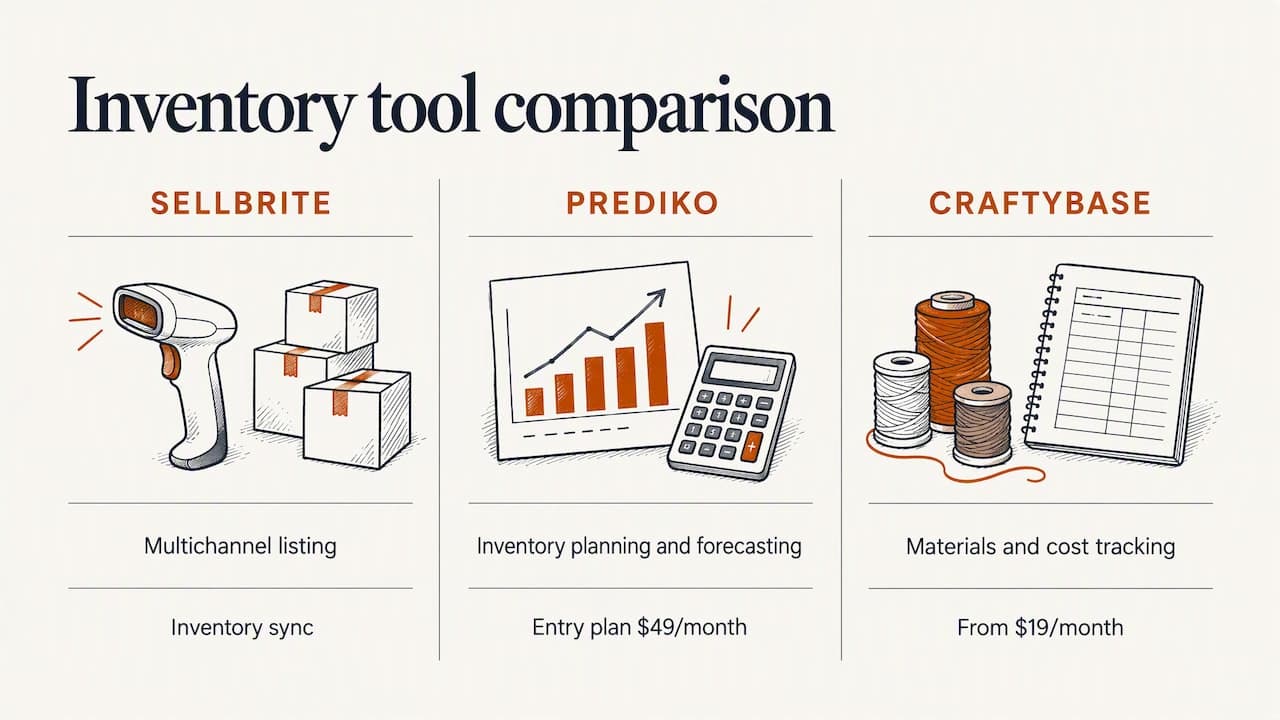
If you sell on Etsy and elsewhere, stock can drift out of sync. A sold-out item that still shows as available leads to cancelled orders and unhappy buyers. “Inventory sync” means one tool updates your stock counts across every place you sell.
Sellbrite is a well-known name for multichannel listing and inventory sync. Prediko focuses on inventory planning and forecasting, and is listed at $49 a month at the entry level on its own site as of our last check. Both are software: you log in, read the data, and make the changes yourself.
Craftybase is another option for makers who need to track materials and costs. According to the same seller tool roundup, it starts at $19/month.
These tools are strongest for shops with many SKUs (a SKU is one distinct product you stock) or several sales channels. A shop with 40 handmade listings may not need that weight.
Done-for-you audits and AI store management
A newer group of options takes work off your plate instead of handing you more data. Here is how the field looks, using each provider’s published positioning. Check each provider’s own page for current terms.
| Option | What it is | Published price | Turnaround | Fixes made for you? |
|---|---|---|---|---|
| ShelfSparrow | Done-for-you store auditing service | $297 audit, then $29/month | Fixes in 72 hours | Yes, on the spot |
| Lydia | AI store management for Shopify and Etsy, audits across 9 categories | $497 one-time audit, then $1,997/month | Report in 48 hours | Report-led |
| Speechify Boost | Audits products, drafts fixes (titles, copy, photos, meta) | Check provider | Weekly digest | Drafts for your approval |
| OptraSeven | Shopify CRO agency, deep audit | $149 founding offer vs. $297 regular price | Check provider | Agency-led |
| Focused Developer | Shopify audit | €150 | Report in 5 business days | Report only |
| Upwork and Fiverr freelancers | Individual audit freelancers | $35 to $1,299 | Varies by freelancer | Mostly report-only, no monthly watch |
| CRO agencies | Conversion-focused agencies | $1,500 to $3,000 or more | Varies | Strategy-led |
(CRO means conversion rate optimization: getting more of your visitors to buy.)
Lydia
Lydia is the closest branded rival. It offers AI store management for Shopify and Etsy, with audits across 9 categories. It charges $497 for a one-time audit with a report in 48 hours, then $1,997/month ongoing. That is a serious budget for a small seller. ShelfSparrow costs $297 for the audit and $29/month ongoing, so it undercuts Lydia at both ends.
Speechify Boost
Speechify Boost audits your products and drafts fixes for titles, copy, photos and meta (the short description search engines show), then sends a weekly digest. You approve each draft before it goes live. That is useful if you want a say in every change. But approvals mean the work waits on you. ShelfSparrow fixes issues on the spot, so typos and broken images do not sit in a queue.
OptraSeven
OptraSeven is a Shopify CRO agency. Its deep audit is listed at $149 as a founding offer, against a $297 regular price. It targets brands doing $200k to $5M a year, and it has no $29/month watchdog offering. If you are a small seller who wants ongoing checks, that is a different lane.
Focused Developer
Focused Developer offers a €150 Shopify audit with a report in 5 business days. It offers money back if it finds fewer than 5 fixes. It is a fair option in the small-shop price range, though it is a report, and you do the repairs.
Freelancers and agencies
Audit freelancers on Upwork and Fiverr run from $35 to $1,299. Most deliver a report only, with no monthly watch afterward. Real CRO agencies charge $1,500 to $3,000 or more for a tactical audit. Both can be right for a specific project. Neither keeps an eye on your shop week after week.
StoreClaw
StoreClaw is another name sellers run into when looking at store tools. Like most in this group, it is something you evaluate and operate. Compare it on the same questions we list below.
Why dashboards alone leave leaks
A “leak” is a small, boring problem that costs you sales without any alarm going off:
- A typo in a title, so shoppers searching the right word never see you.
- A broken or missing image, so the listing looks abandoned.
- A tag or description left blank after a rushed edit.
- An item that sold out on another channel but still shows as available.
- A low-stock item you did not notice until it hit zero.
Most tools surface these as data. You then have to notice, decide and fix. For a one-person shop, that last part is what slips.
Perspective: why we built a service, not another dashboard
We talk with a lot of small sellers. Almost none say they lack data. They say they lack time.
That is why ShelfSparrow is a done-for-you store auditing service, not software. You do not learn a new screen. We audit your listings, fix titles, SEO, typos and broken images, and send a plain-English, prioritized report so you know what changed and what matters most.
After that, we keep a steady eye on things. Listing checks, stock alerts and a short daily summary arrive without you opening anything. Routine errors get corrected, and low stock gets flagged before it becomes a sold-out page.
We think the real cost of a messy shop is not the one big mistake. It is the dozens of small ones that send a shopper to the cleaner store next to yours. A little order, all day long, is what keeps a small shop calm.
Francis
How to choose: a short checklist
Before you pay for anything, answer these:
- What is your biggest time sink? Keyword research, stock tracking or cleanup? Buy for that one.
- Does it fix or only report? A report is useful. A fix is finished work.
- What is the all-in monthly cost? Add the entry price, any add-ons and the hours you will spend using it.
- How many channels do you sell on? One channel needs less than five.
- Will it keep watching? One-time audits go stale. Ask what happens in month three.
- Can you leave easily? Prefer monthly plans over long contracts when your shop is small.
A simple stack for many small sellers: Etsy Shop Manager for orders, a free or low-cost research tool for keywords, and a service that keeps the listings clean.
What a ShelfSparrow audit and watch covers
Here is what you get, and what you pay.
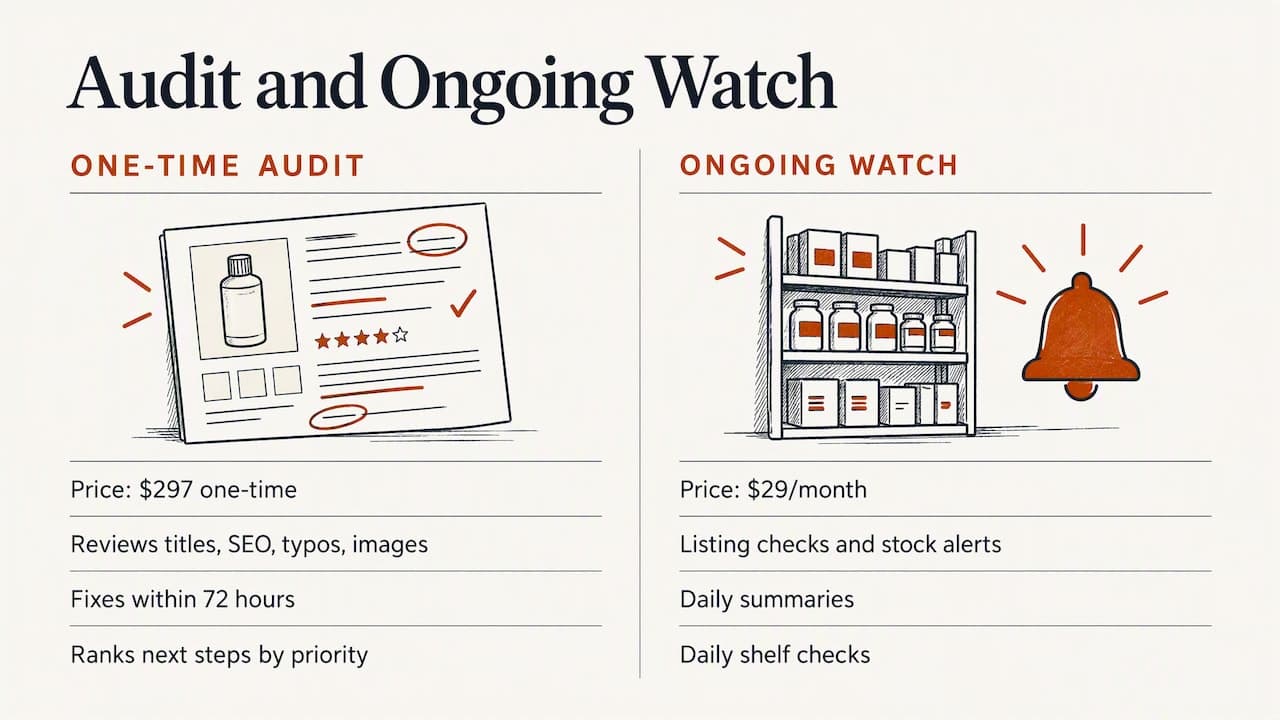
One-time audit: $297. Your listings are reviewed for titles, SEO, typos and broken images. Fixes are made within 72 hours. You get a plain-English report that ranks what to do next, from most to least important.
Ongoing watch: $29/month. Listing checks, stock alerts and daily summaries. Think of it as someone walking your shelves every day.
We audit any online store or marketplace, including Amazon, Walmart, eBay and WooCommerce, along with Shopify and Etsy. If you sell in more than one place, one team can look after all of it.
Ready to try it?
If your shop has more listings than you can recheck by hand, start with the audit. It clears the backlog, and the monthly watch keeps it cleared. See the details on our store audit page, or read more on the ShelfSparrow home page.
Prefer to start small? The $29/month plan is there for sellers who just want a steady eye on their shop.
FAQ
What is the best free Etsy shop management tool?
Etsy’s own Shop Manager is the best free starting point. It handles listings, orders, stats and promotions, and the Etsy Seller app brings much of it to your phone. eRank and EverBee also offer free tiers if you want keyword research on top.
Do I need paid software to manage an Etsy shop?
Not at first. A small shop can run on Shop Manager alone. Paid tools start to pay off when you have many listings, sell on several channels, or lose hours to keyword research and cleanup.
What is the difference between a tool and a done-for-you service?
A tool gives you screens and data, and you do the work. A done-for-you service does the work. ShelfSparrow is the second kind: we fix titles, SEO, typos and broken images, then keep checking.
How much does it cost to audit an Etsy shop?
Prices range widely. Freelancers on Upwork and Fiverr run $35 to $1,299, and CRO agencies charge $1,500 to $3,000 or more. ShelfSparrow’s audit is $297 one-time, with $29/month for ongoing checks.
Can one service cover more than Etsy?
Yes. ShelfSparrow audits any online store or marketplace, including Amazon, Walmart, eBay and WooCommerce, so sellers on several sites do not need a separate vendor for each.